.png)
From Order to Delivery: EDI Integration for WMS & 3PL
While everyone else has been enjoying the sunshine, we've been working on new EDI WMS integration features to make it easier for businesses to connect their ERP, third-party logistics providers and warehouse management systems.
And the goal is simple:
Make it easier for businesses to connect their ERP, EDI, warehouse and transport processes from-order-to-delivery-edi-integration-for-3pl-wms— without adding more manual work.
EDI WMS Integration Connections
More and more businesses are choosing to outsource warehousing, picking, packing and shipping to a third-party logistics provider.
That makes sense. You can let a specialist manage your warehouse operations while you focus on your own business.
But there’s an important question: How does your order get from your system to their warehouse?
This is where EDI can make a big difference.
When we receive an order, EDI Connector can process the order and forward the relevant information directly to the third-party WMS or logistics system.
So instead of someone downloading an order, emailing it to the warehouse or manually entering it into another system, the information can flow automatically.
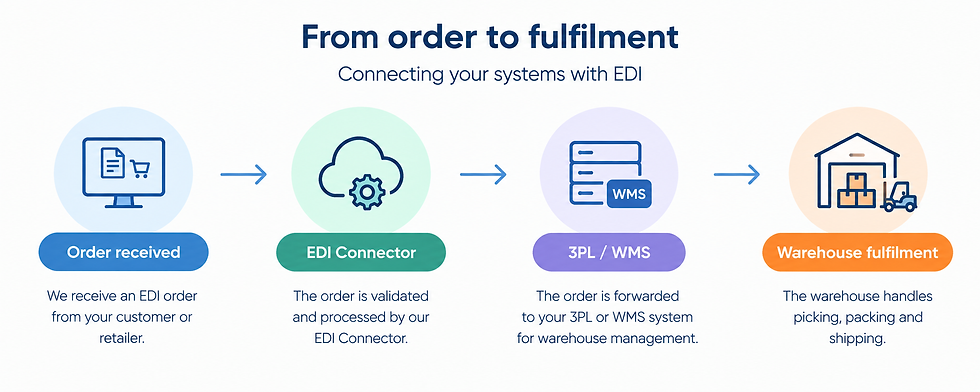
The warehouse can then take care of the next steps: picking, packing and shipping.
Sending INSDES Instructions to Your 3PL
Orders aren't the only information that needs to reach a 3PL.
In some workflows, a third-party transport or warehousing company also needs to receive an INSDES (Instruction to Despatch) message.
Our EDI Connector can receive that EDI message and forward it to the relevant third-party system.
This means the warehouse or logistics provider gets the information they need to organise the stock and carry out the required fulfilment process.
Again, the aim is to remove unnecessary manual steps and keep everyone working from the same information.
From WMS Shipment Data Back to Your ERP
EDI integration shouldn't stop once the warehouse receives the order.
Once the goods have been picked, packed and shipped, the 3PL or WMS can send shipment information back.
For example, this could be sent as a DESADV (Despatch Advice) or other shipment data.
EDI Connector can then process that information and pass it back into the customer's ERP or other connected system.
So the information flow becomes a two-way conversation:

This gives businesses much better visibility of what has happened to an order without someone having to chase the warehouse for an update.
What if you don't have your own Order Management System?
Not every business has a sophisticated ERP or order management system — and that's okay.
EDI Connector can also provide a portal where customers can manage and view their order information.
This means a business can still take advantage of automated EDI communication with its 3PL, even if it doesn't have a separate order management platform of its own.
EDI Connector can effectively sit in the middle, connecting the different parts of the process.
One EDI Connection, Multiple Systems
This is the part we're particularly excited about.
A modern fulfilment process can involve quite a few different systems and organisations:

And information needs to travel back up that chain too.
Rather than treating each connection as a separate problem, EDI Connector can act as the link between these systems.
That means your ERP doesn't necessarily need to communicate directly with every warehouse or logistics provider.
Your 3PL doesn't need to work in your ERP.
And your warehouse doesn't need access to systems that aren't relevant to them.
EDI handles the communication between them.
Why we've been working on this
For us, EDI isn't just about sending a message from A to B.
It's about making sure the right information reaches the right system at the right time, and that information can make its way back again.
As businesses increasingly use external warehouses, fulfilment providers and transport companies, the need for reliable integrations between these systems is only growing.
That's why we've been investing time in making EDI Connector more capable of supporting these workflows.
Whether you already work with a 3PL or you're considering outsourcing your warehousing and fulfilment, your EDI setup shouldn't become another obstacle.
It should make the process easier.
What's next?
We're continuing to develop the EDI Connector around real-world customer requirements — connecting ERP systems, EDI, WMS platforms, logistics providers and everything in between.
If you're working with a 3PL and wondering how to connect your orders and shipment information, or you're struggling with an existing EDI integration, we'd be happy to talk.
Your warehouse might be somewhere else....
Your ERP might be on another platform....
Your transport provider might use a completely different system....
That's exactly what EDI integration is there to solve.


Comments